Book a DemoBack to Home
VR Training for Aerospace
Aerospace & Aviation

VR Training for
Aerospace & Aviation MRO

Aircraft are too valuable, too complex, and too safety-critical for conventional training to be adequate. EDIIIE builds full-scale VR hangar simulators that train your technicians, engineers, and ground crew to regulatory-standard competency — without touching live aircraft.

45%
Reduction in Training Time
Zero
Aircraft Damage During Training
92%
Average Competency Score
DGCA/
EASA
Aligned Competency Standards
The Problem

The Training Challenge in Aerospace

Aviation is the most safety-regulated industry in the world — and its training challenges are uniquely demanding.

Limited Aircraft Availability
Aircraft are expensive operational assets — every hour used for training is an hour not generating revenue. For MRO organisations and training academies, scheduling training time on live aircraft is a constant bottleneck that limits throughput and extends the time from enrolment to qualified technician.
Cost of Training Errors
An error during maintenance training on a live aircraft — a dropped tool inside a fuel tank, incorrect panel torquing, a missed inspection step — can cause equipment damage running to millions of rupees or, worse, create a latent airworthiness defect. The consequences of training on live assets are disproportionate to the learning value.
Regulatory Compliance Complexity
DGCA, EASA, and FAA maintenance training requirements specify detailed competency standards, training record requirements, and assessment criteria. Meeting these requirements consistently across a growing workforce, while demonstrating documented compliance to regulatory inspectors, demands a structured, systematic training approach.
Our Solution

Full-Scale VR Aircraft Maintenance Simulators

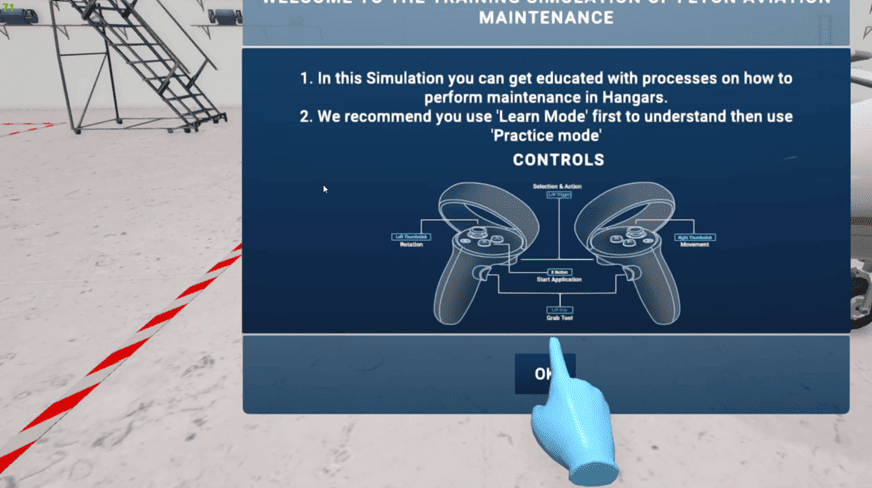
EDIIIE creates full-scale photorealistic aircraft hangar environments in VR — accurate to the actual aircraft type, component layout, and maintenance access panels. Technicians interact with virtual tools, access engine bays, perform scheduled inspections, and follow AMM-compliant procedures using VR hand controllers.

Proven with Flyon Aero (EASA IT.147.0016), our dual-mode Learn + Practice + Assessment architecture delivers measurable competency outcomes aligned to DGCA and EASA Part-66 licensing requirements.

See a Demo
VR Aircraft Maintenance Training
AMM Procedure Training
Aircraft Maintenance Manual procedure walkthroughs in VR — step-by-step, narrated, with error detection and corrective feedback at each task stage.
Component Inspection Simulation
Train inspectors to identify wear, corrosion, crack propagation, and other defects on virtual components — building detection skill without consuming limited physical samples.
Tool Handling & FOD Prevention
Interactive tool selection, correct application, and Foreign Object Damage prevention training — instilling the disciplined tool accountability habits that prevent serious airworthiness events.
DGCA/EASA Competency Records
Automatic generation of training records, competency scores, and assessment reports aligned to Part-66 and Part-147 requirements — simplifying regulatory compliance documentation.
45%
Reduction in Training Time
vs. Live Aircraft
Zero
Aircraft Damage Incidents
During VR Training
92%
Average Competency Score
Across Trained Cohorts
60%
Reduction in Dependency
on Senior Engineers
Applications

VR Use Cases in Aerospace & Aviation

From ground crew induction to licenced aircraft maintenance engineer training — EDIIIE covers the full aviation training spectrum.

Scheduled Maintenance Procedures
A-check, B-check, C-check task procedure training in VR — technicians practice each AMM task in sequence, with error detection and sign-off simulation aligned to airline MOE requirements.
Engine Run-Up & Power Plant Training
Train mechanics on engine start procedures, power plant removal, and test cell run concepts in a risk-free VR environment that eliminates jet blast, noise, and fuel hazards during training.
Fire Safety & Ground Emergencies
Simulate hangar fire response, aircraft evacuation support, fuel spill procedures, and ground emergency coordination — building reflexive emergency response capability in ground crews.
Pre-Flight & Walk-Around Inspection
Train pilots and ground engineers on correct walk-around inspection sequences — identifying anomalies, documenting findings, and escalating airworthiness concerns before departure.
Cadet & Student Pilot Familiarisation
Cockpit systems familiarisation, instrument recognition, and emergency procedure introduction for student pilots — accelerating ground school learning before simulator and flying hours begin.
Airside Safety & Ground Operations
Ramp safety induction, aircraft parking procedures, marshalling signals, and FOD walk training for all ground operations personnel — reducing the leading causes of serious incident on the apron.
Client Success

Aerospace Training in Action

Flyon Aero VR Aircraft Maintenance Training
General Aviation MRO
Flyon Aero — EASA IT.147.0016 Certified Training Organisation
VR Aircraft Maintenance Training Simulator for Hangar Technicians
ChallengeFlyon Aero needed a scalable, cost-effective way to train technicians on hangar procedures without continuous access to live aircraft — expensive assets with limited training availability, and where training errors carry serious airworthiness and regulatory risk.
SolutionEDIIIE created a full-scale VR maintenance training simulator set inside a photorealistic aircraft hangar — dual-mode Learn + Practice design, tool grab mechanics, step-by-step AMM-compliant procedure walkthroughs, error detection, and DGCA/EASA-aligned scoring.
OutcomeTechnicians reached procedural competency in significantly less time than live-aircraft training. Zero aircraft damage incidents. A consistent, measurable training baseline across all cohorts, with reduced dependency on senior engineers for supervision.
↓45%
Training Time
Zero
Aircraft Damage
↑92%
Competency Score
Why It Works

Why VR Works for Aerospace Training

Aviation has zero tolerance for error — and VR is the only training technology that builds genuine procedural competence before any risk is introduced.

The Aircraft is Always Available
A virtual aircraft is never on a flight schedule, never in for an AOG repair, never unavailable because it's generating revenue. Your training programme runs on your timeline, not the maintenance schedule's — enabling consistent, uninterrupted skill development.
Procedural Memory Through Muscle Memory
VR hand controllers simulate the actual physical actions of maintenance tasks — reaching into an engine bay, selecting and applying a tool, following a torque sequence. This builds genuine procedural muscle memory, not just theoretical knowledge of the AMM.
Regulatory-Standard Documentation
EDIIIE's platform auto-generates training records with the data points regulators want: task completed, time taken, errors made, score achieved, date and time. This creates a continuous, auditable competency record that satisfies DGCA and EASA inspection requirements.
Ready to Ground Your
Training Programme in Excellence?

Talk to our aerospace training specialists about a VR solution aligned to your fleet type, regulatory requirements, and technician development goals.

Frequently Asked Questions

Common Questions

Questions commonly asked by training managers, safety officers, and procurement teams — answered directly.

Aviation maintenance training is among the most heavily regulated in any industry. Key frameworks include EASA Part-147 (Europe), FAA Part 147 (US), DGCA CAR-147 (India), and their equivalents in other jurisdictions. These regulations specify the syllabuses, hours, instructor qualifications, and assessment standards for each aircraft type rating and maintenance licence category. Approved training organisations (ATOs/BATOs) must deliver training to these standards. Simulation and VR are accepted as compliant training media within most regulatory frameworks provided the content maps to the approved syllabus and records meet documentation standards.
Aviation maintenance training has a critical constraint: access to a live aircraft for training competes directly with revenue-generating operations. VR removes this constraint — technicians practise disassembly, inspection, fault diagnosis, and reassembly on a detailed simulation of the specific aircraft type, at any time, without affecting airworthiness or scheduling. Repeated practice on complex procedures — particularly those with high error potential — builds competency that transfers directly to live aircraft performance. Clients report significant reductions in maintenance errors and inspection failures after structured VR training.
Airlines, MROs, and defence aviation organisations with large maintenance workforces face the challenge of managing type-specific competency, licence currency, and recurring training compliance across hundreds or thousands of technicians. A VR training system with integrated LMS automates this — tracking training completion, assessment scores, and certification currency by technician, aircraft type, and system. Automated alerts flag upcoming expiries. Audit-ready records are available on demand. For multi-base operations, all certification data feeds into a single compliance dashboard regardless of where the technician is based.
A detailed VR simulation of the specific aircraft type — built from approved maintenance documentation, technical drawings, and physical reference where available — allows technicians to practise the full maintenance procedure in a realistic 3D environment. They can interact with virtual components, follow procedure walkthroughs, identify introduced faults, and be assessed on procedural accuracy. This is used for initial type training (before a technician's first live aircraft access), recurrency training between live aircraft events, and for rare procedures that are difficult to schedule on live aircraft.
Aircraft maintenance errors carry both direct and systemic costs: rectification costs for the specific error, potential aircraft-on-ground (AOG) time, investigation and reporting overhead, and — in serious cases — airworthiness risk and regulatory consequences. The indirect cost of maintenance errors to an airline or MRO frequently runs to multiples of the direct rectification cost. Structured VR training on complex, error-prone procedures has demonstrated meaningful reductions in error rates on live aircraft in multiple deployment studies, with ROI driven primarily by AOG avoidance and rectification cost reduction.
Under EASA Part-147 and DGCA CAR-147, simulation and computer-based training are accepted training media within an approved training organisation's programme, subject to the specific content mapping to the approved syllabus and the training organisation's approval covering simulation use. Simulation does not automatically replace all practical training requirements — the regulatory position on which elements must be completed on live aircraft varies by system, task, and licence category. We design training content to meet the requirements of your specific approved programme and regulatory framework.

Have a question not answered here?

Ask Us Directly