Book a DemoBack to Home
Augmented Reality on Factory Floor
AR Training Solutions

Augmented Reality.
At the Point of Work.

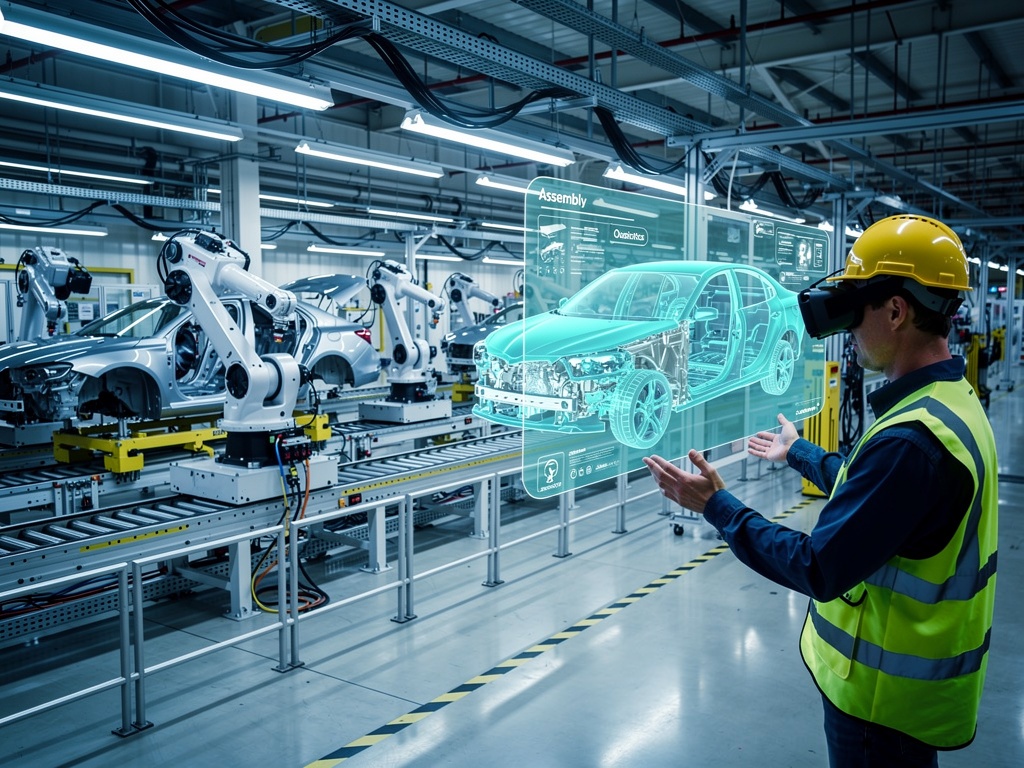
Overlay digital guidance, safety alerts, and procedural instructions directly onto real equipment and real environments. AR delivers the right information to the right worker at exactly the right moment — without taking them away from the job.

60%
Reduction in Procedure Errors
40%
Faster Task Completion
800+
AR Experiences Built
10+
Years of Expertise
The Challenge

The Cost of Disconnected Training

Classroom training is forgotten. Printed SOPs are ignored. AR bridges the gap between knowing and doing — in the moment, at the point of work.

SOPs Are Ignored at the Point of Work
Workers trained in classrooms rely on memory during complex tasks. Printed manuals are rarely consulted mid-procedure, leading to missed steps, quality failures, and safety incidents.
Expert Knowledge Doesn't Scale
Senior technicians carry decades of tacit knowledge that cannot be transferred through documentation. When they are unavailable, errors increase and downtime follows.
Costly Re-Training Cycles
Process changes, new equipment, or regulatory updates require re-training entire workforces. Traditional methods are too slow and too expensive to keep pace with operational change.
Quality Inspection Inconsistency
Manual inspection processes vary by inspector. Without a standardised, guided approach, defects go undetected — increasing rework, recalls, and compliance risk.
Our AR Approach

How EDIIIE AR Transforms Workforce Performance

From guided assembly to remote expert support, our AR solutions integrate with your real-world environment to deliver contextual intelligence exactly when it is needed.

Step-by-Step Procedure Overlay
Digital instructions appear directly on equipment — guiding technicians through maintenance procedures, assembly sequences, and inspection checklists in the exact spatial context they are working in.
Remote Expert Assistance
Field workers stream their live view to remote specialists who annotate what they see in real time. Complex issues get resolved faster without expensive travel or prolonged downtime.
Guided Quality Inspection
AR overlays highlight inspection points, tolerance parameters, and defect detection zones on physical components — ensuring every inspector follows the same standard, every time.
Safety Hazard Alerting
Proximity warnings, arc flash zones, confined space boundaries, and PPE reminders displayed contextually in the field of view — reducing incidents through ambient awareness.
On-the-Job Skill Transfer
New workers learn by doing, with AR overlays providing guidance while they perform real tasks — compressing time-to-competency without pulling experienced staff off the floor.
Multi-Device Deployment
Deploy on smart glasses, tablets, or smartphones — giving flexibility to match the form factor to the work environment, whether a cleanroom, production line, or remote field site.
Use Cases

Where AR Delivers the Most Value

AR is most powerful at the intersection of complex tasks, distributed workforces, and high consequences for error.

Maintenance & MRO
Technicians follow AR-guided procedures on live equipment — reducing diagnostic time, preventing incorrect sequences, and eliminating reference to paper manuals.
Assembly & Manufacturing
AR guidance on assembly lines reduces defects and rework by ensuring every operator follows the identical procedure, regardless of experience level.
Site Safety Induction
New workers receive an AR-guided site orientation — hazard zones, emergency exits, PPE requirements, and site-specific rules delivered spatially before they start work.
Compliance Auditing
Inspectors use AR-guided checklists overlaid on physical locations — ensuring nothing is missed and every finding is logged digitally in real time.
Medical Device Guidance
Clinical staff receive step-by-step AR guidance when operating unfamiliar or infrequently used medical equipment — reducing errors and improving patient safety.
Utilities & Field Service
Field engineers working on substations, pipelines, or infrastructure receive contextual AR guidance that reduces errors on complex, safety-critical systems.
In Deployment

AR Solution in Action

Real deployments. Enterprise environments. Measurable outcomes.

AR Overlay on Industrial Equipment

images/ar-industrial-overlay.jpg

AR Maintenance Guidance — Step-by-Step Overlay

images/ar-maintenance.jpg

AR Quality Inspection — Defect Detection

images/ar-quality.jpg

The EDIIIE Difference

Why Organisations Choose Us

We are not a generic content studio. We are an immersive simulation company with deep domain expertise across the sectors we serve.

Process-Accurate Simulation
Every environment is built from your actual SOPs, engineering drawings, and equipment specifications — validated by your SMEs before any deployment.
End-to-End Delivery
Strategy, content design, development, deployment, and analytics — all from one team. No fragmented vendors, no gaps in accountability.
200+ In-House Specialists
Our developers, 3D artists, instructional designers, and domain experts work entirely in-house — delivering quality and speed that outsourced models cannot match.
Proven at Global Scale
170+ enterprise projects across defence, heavy industry, aerospace, healthcare, and government. We have solved deployment challenges most simulation studios have never encountered.
Ready to Put AR to Work in Your Operations?

Tell us where errors, downtime, or knowledge gaps are costing you most — we'll design an AR solution built around your environment.

Frequently Asked Questions

Common Questions

Questions commonly asked by training managers, safety officers, and procurement teams — answered directly.

AR overlays digital instructions, 3D models, and contextual data directly onto real equipment and working environments via a smartphone, tablet, or smart glasses. In manufacturing it is used for assembly guidance (step-by-step instructions overlaid on the actual part), maintenance and repair walkthroughs, quality inspection with tolerance overlays, and operator training on equipment interaction. The core benefit is that the worker stays eyes-on their actual task rather than switching between a manual and the work.
Yes. Multiple industrial deployments have demonstrated 30–50% reductions in procedural errors during complex maintenance tasks after AR work instruction adoption. The mechanism is that AR eliminates the cognitive load of cross-referencing a paper manual or screen while physically working — instructions are anchored spatially to the actual component the technician is touching. Error rates drop further when AR includes embedded checkpoints that prevent a technician from progressing to the next step before completing the current one correctly.
Most industrial AR applications run on standard iOS or Android smartphones or rugged tablets — no specialist hardware required. For hands-free applications where the worker needs both hands on the equipment, smart glasses including RealWear HMT-1, Microsoft HoloLens 2, and Vuzix are used. Hardware selection depends on whether hands-free operation is required, the ambient lighting conditions (outdoor sunlight affects some display types), and whether the environment requires intrinsically safe or explosion-rated devices.
A paper manual requires the technician to find the right page, interpret 2D diagrams, and mentally translate them to the 3D component in front of them — while holding tools and remembering their place. AR work instructions appear spatially anchored to the actual component, step-by-step in sequence, with 3D animations showing exactly what to do and where. Embedded checkpoints confirm each step before the next appears. The result is faster task completion, lower error rates, and a digital completion record — all of which a paper manual cannot provide.
Yes. AR work instructions can be triggered by asset tags, QR codes, or work order IDs pulled from your CMMS or ERP, so the technician sees the correct procedure for the specific asset and work order they are on. Completion data, inspection outcomes, and any recorded deviations are pushed back to the maintenance management system automatically. This creates a closed loop between work instruction delivery and record-keeping, and eliminates manual data entry from the technician's workflow.
Implementation starts with identifying the highest-value use cases — typically the procedures with the highest error rates, longest completion times, or greatest dependency on experienced instructors. Content is developed for those procedures first, validated with your technical SMEs, and piloted with a small group of technicians. The pilot generates performance data that justifies wider rollout. A full factory-wide AR implementation is phased over months, not done in one go. Hardware deployment, connectivity setup, and integration with existing systems are scoped and delivered alongside content development.

Have a question not answered here?

Ask Us Directly