Book a DemoBack to Home
AR/VR Training for Defence
Defence Military DRDO

AR/VR for Defence
Training & Operational Readiness

Transforming Training · Operations · Readiness. EDIIIE (Dhi Tattva Solutions Pvt. Ltd.) brings 10+ years of expertise in deploying advanced AR, VR, and Digital Twin technologies for the defence sector — from DRDO laboratories to Naval Academies.

60%
Reduction in Training Exercise Costs
10+
Years in Defence Immersive Training
100%
Zero Operational Risk During Training
Improved Scenario Retention
Our Defence Expertise

A Trusted Technology Partner for India's Defence Ecosystem

Under the brand EDIIIE (Dhi Tattva Solutions Pvt. Ltd.), our defence practice focuses on enhancing operational capacities and readiness through immersive, effective, and future-ready simulation experiences.

We have partnered with leading defence institutions including Defence Research & Development Organisation (DRDO) – Jodhpur and the Indian Naval Academy (INA), Ezhimala, delivering specialised immersive environments and simulation solutions tailored to complex operational training needs.

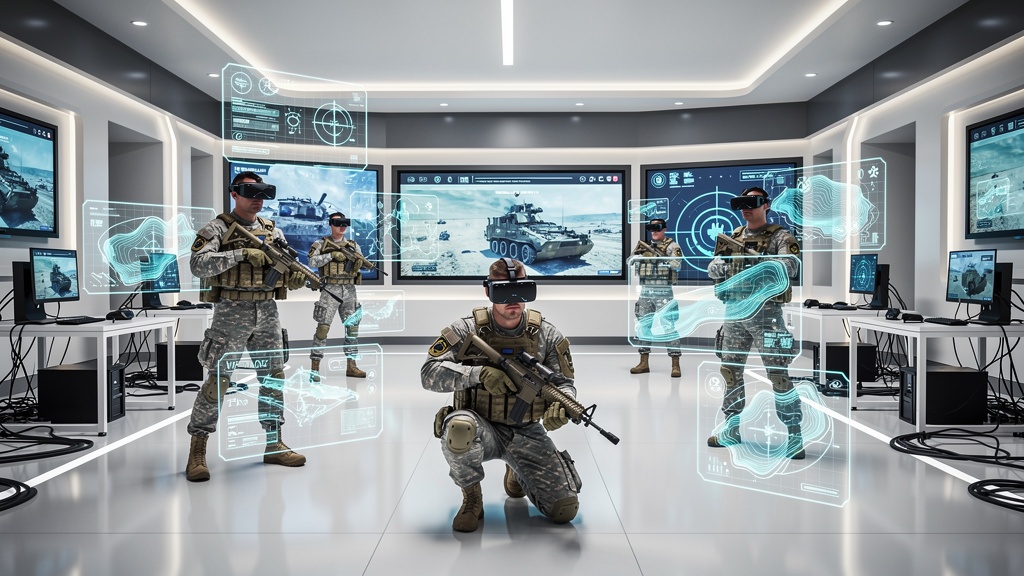
Our technology stack includes standalone VR headsets, Mixed Reality (MR) systems, AR overlays, Digital Twins, AI-integrated scenarios, and custom hardware-software integration for defence-grade deployment environments.

Defence VR Training
Our Clients

Defence & Strategic Sector Clients

EDIIIE has delivered immersive training solutions across the world's most strategically important defence and research institutions.

DRDO — Defence Laboratory Jodhpur (DLJ)
Delivered specialised immersive simulation environments for research and operational training use cases at Defence Laboratory Jodhpur, part of India's premier defence R&D organisation.
Indian Naval Academy (INA), Ezhimala
Developed tailored immersive environments and simulation solutions for the Indian Naval Academy — India's premier naval officer training institution — supporting cadet training and operational familiarisation programmes.
Govt. of Rajasthan — Bhamashah Scheme
Delivered large-scale digital awareness and simulation training programmes for state government beneficiaries, covering civic procedures, scheme workflows, and citizen service navigation in immersive environments.
The Problem

Training Challenges in Defence

Defence training requirements are uniquely demanding — high stakes, complex systems, costly assets, and scenarios that cannot be safely replicated in live environments.

High-Risk Scenario Training
Combat procedures, weapon system operations, NBC (Nuclear, Biological, Chemical) threat response, and tactical mission rehearsal involve inherent risks and significant resource expenditure when conducted with live assets. Replicating these scenarios safely at training scale is a persistent challenge for all defence forces.
Expensive Asset Constraints
Naval vessels, fighter aircraft, armoured vehicles, and missiles are extremely expensive assets with limited availability for training purposes. Training errors on live platforms carry catastrophic consequences — yet operators need extensive practice hours to achieve and maintain mission-ready status.
Classified Environment Replication
Many defence training scenarios involve classified equipment, sensitive operational procedures, and environments that cannot be disclosed or reproduced outside of controlled settings. Creating training content that meets both pedagogical and security requirements demands specialised technical and clearance expertise.
Our Capabilities

AR/VR Solutions for Defence

EDIIIE's defence technology portfolio spans immersive simulation, digital twin environments, and AI-enhanced training systems.

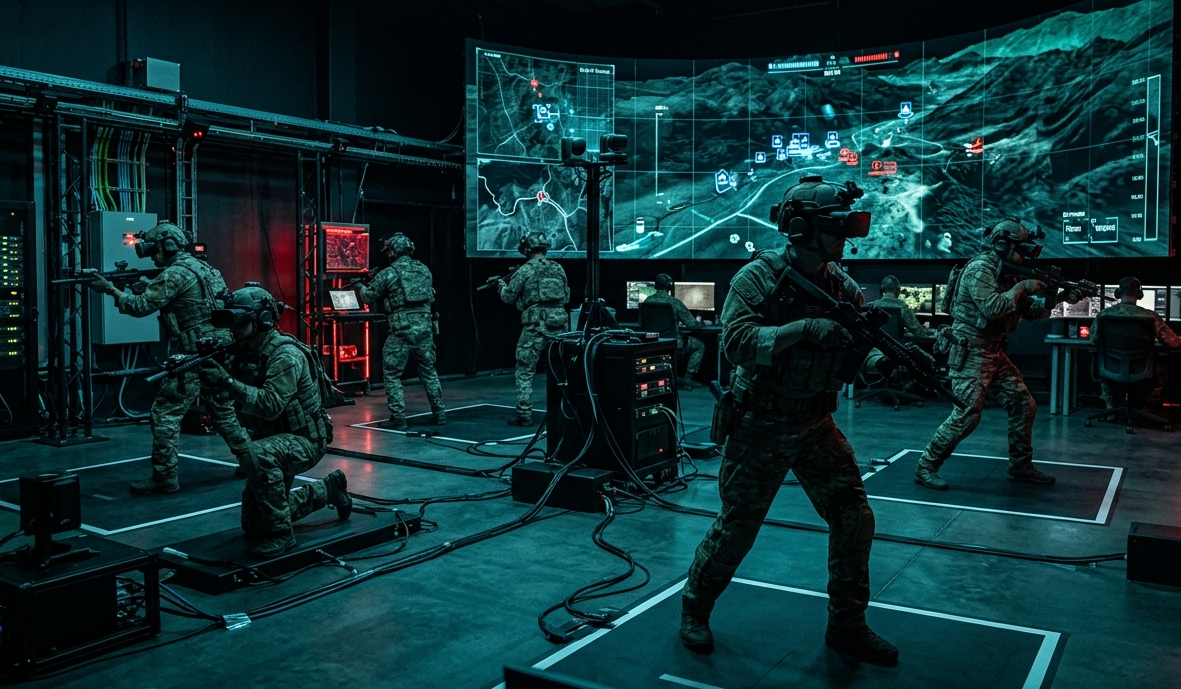
Mission Rehearsal VR
Immersive pre-mission scenario rehearsal environments allowing teams to walk through objectives, routes, and contingencies before deployment.
AR for Equipment Maintenance
Augmented Reality overlays on complex weapon systems, vehicles, and equipment — providing real-time guided maintenance instructions for technicians in the field.
Digital Twin Simulations
Accurate digital twins of defence assets — ships, aircraft, ground systems — enabling operational analysis, crew training, and maintenance planning without live asset access.
AI-Enhanced Training Scenarios
AI-driven adversarial agents and adaptive scenario difficulty — ensuring training environments evolve to challenge operators at the appropriate level as their skills improve.
60%
Reduction in
Training Exercise Costs
10+
Years of Defence
Immersive Technology
100%
Scenario Fidelity
Zero Operational Risk
Improved Tactical
Scenario Retention
Applications

AR/VR Use Cases in Defence Training

From officer cadets to operational units — EDIIIE's solutions support the full spectrum of defence training requirements.

Tactical Mission Rehearsal
Walk through mission objectives, terrain analysis, and contingency planning in photorealistic VR environments — reducing uncertainty and improving team coordination before actual operations.
Naval Platform Familiarisation
Virtual walkthroughs and system operation training for naval vessels — enabling cadet and crew familiarisation with ship layouts, machinery spaces, and damage control procedures without sea deployment.
NBC Threat Response Training
Immersive simulation of Nuclear, Biological, and Chemical threat scenarios — training personnel on detection procedures, decontamination protocols, and protective equipment usage in a completely safe environment.
Weapon System Operations
VR-based training on weapon system controls, loading procedures, targeting interfaces, and safety protocols — reducing live-range time requirements and improving operator readiness metrics.
Combat Casualty Care (TCCC)
Tactical Combat Casualty Care training in immersive VR — practising haemorrhage control, airway management, and field evacuation procedures under simulated combat stress conditions.
Research & Development Support
Collaborative VR/AR environments for DRDO and defence research institutions — enabling equipment visualisation, prototype review, and operational concept testing before physical manufacture.
Client Engagement

Defence Training in Action

Defence VR Training
Government & Defence Research
Defence Research & Development Organisation (DRDO) & Indian Naval Academy (INA)
Immersive Simulation Environments for India's Premier Defence Institutions
ChallengeMission-critical operational training required high-fidelity simulation environments that could replicate complex, classified scenarios without exposing personnel to live-system risk or incurring the cost of full-scale live exercises.
SolutionEDIIIE designed and deployed classified VR simulation modules and immersive environments tailored to the specific operational and research requirements of DLJ–DRDO and Indian Naval Academy — incorporating mission rehearsal, equipment familiarisation, and scenario-based assessment.
OutcomeSignificant cost reduction in training exercise expenditure, improved readiness scores among trained personnel, and a sustainable, scalable immersive training infrastructure established at both institutions.
↓60%
Training Exercise Cost Reduction
100%
Safe, Classified Environment
↑3×
Scenario Retention
Why It Works

Why AR/VR is Transforming Defence Training

The demands of modern warfare require training that matches the complexity, pace, and unpredictability of real operations — traditional classroom methods simply cannot deliver that.

Simulate the Unsimulatable
VR can recreate combat environments, NBC incidents, ship damage scenarios, and weapon system failures — training personnel for the scenarios that matter most, at a fraction of the cost and with zero operational risk to people or equipment.
Unlimited Repetition, Zero Degradation
Unlike live ammunition exercises or costly simulation facilities with limited booking windows, VR enables unlimited repetition of any scenario. Operators can run the same complex manoeuvre 100 times until it is instinctive — without any per-run cost.
Objective Readiness Assessment
Every training run generates objective performance metrics — decision time, procedure accuracy, error frequency, team coordination scores. Command has real, data-driven evidence of unit readiness — not just supervisor assessments and attendance records.
Ready to Advance Your
Defence Training Capabilities?

Request a confidential briefing with EDIIIE's defence solutions team to explore how AR/VR can enhance your organisation's training and operational readiness.

Frequently Asked Questions

Common Questions

Questions commonly asked by training managers, safety officers, and procurement teams — answered directly.

Defence training requirements span operational readiness, equipment competency, safety, and compliance. Core categories include: weapon system operation and safety, tactical scenario training, first aid and combat casualty care, NBC (nuclear, biological, chemical) awareness and response, physical fitness and survivability skills, cyber and information security, equipment maintenance and fault diagnosis, and role-specific technical qualifications. Requirements are set by service doctrine, standing operating procedures, and legislative frameworks specific to each defence organisation. Simulation is increasingly mandated as a component of formal training syllabuses in NATO and allied forces.
Defence training has a fundamental constraint: the scenarios that matter most — combat, ordnance handling, NBC response, high-risk equipment operation — are too dangerous or expensive to train on live at adequate frequency. VR removes the frequency constraint entirely. Personnel can experience and respond to critical scenarios repeatedly, in realistic simulated environments, with performance tracked at the individual and unit level. Unlike classroom instruction, VR builds the automatic responses and decision-making habits that matter under operational stress.
A simulation-based assessment platform captures multi-parametric performance data — accuracy, decision speed, procedural correctness, reflex timing, and where biometric hardware is integrated, physiological stress response. All data is stored with a full time-stamped record of every decision. This supports individual competency certification, identification of training gaps at unit level, and aggregated readiness assessment across formations. Centralised LMS deployment allows training records from all installations to feed into a single command-level dashboard.
This is the primary justification for simulation in defence. Training on live ordnance, live weapon systems, live threat environments, or complex emergency scenarios carries unacceptable risk and extraordinary cost at training-adequate frequency. VR and simulation allow these scenarios to be replicated with full operational realism — the same decision points, the same time pressure, the same consequence modelling — in a completely safe and repeatable environment. Personnel build genuine operational competency without the risk and cost of live exercise.
Simulation systems for classified environments are configured for fully air-gapped operation — no internet connectivity, no cloud dependency, and data sovereignty maintained entirely within the client's own infrastructure. Hardware and software are specified to meet the physical and cyber security requirements of the operating environment. All development personnel operate under NDA, and where required by the client organisation, appropriate security clearance procedures are followed. We have experience delivering systems into restricted environments across multiple defence jurisdictions.
The primary cost drivers in live training are ordnance expenditure, platform operating costs (aircraft, vehicles, vessels), range and facility charges, and the logistical overhead of assembling training scenarios at sufficient frequency. Simulation replaces or supplements live training for the scenarios where frequency and realism matter most — at a fraction of the per-sortie or per-exercise cost. Units can train to standard more frequently, on a wider range of scenarios, without the scheduling constraints and cost of live exercises. The result is higher readiness at lower cost.

Have a question not answered here?

Ask Us Directly