Book a DemoBack to Home
VR Training in Manufacturing
HomeIndustriesManufacturing
Manufacturing

VR Training for
Manufacturing Operations

From assembly lines to blast furnaces — EDIIIE builds photorealistic VR simulations that train your workforce faster, safer, and at scale. No production downtime, no live-equipment risk.

75%
Reduction in Training Time
80%
Fewer Workplace Incidents
275%
Average ROI on VR Training
40%
Improvement in Knowledge Retention
The Problem

The Training Challenge in Manufacturing

Traditional training methods in manufacturing environments are slow, inconsistent, costly, and carry serious injury risk.

High-Risk Live Training
Training on active production equipment exposes workers to dangerous machinery, extreme temperatures, toxic chemicals, and high-voltage systems. One mistake can cause permanent injury or fatality. Manufacturers cannot afford these risks during the learning curve of a new hire.
Slow, Inconsistent Onboarding
Shadow-training and classroom instruction vary wildly between trainers, sites, and batches. New operators may take 8–16 weeks to reach basic competency on complex machinery. Each week of underperformance costs production capacity and multiplies quality risk on the line.
Production Downtime & High Costs
Every hour a production line is used for training is an hour of lost output. Demonstration runs waste raw materials, consumables, and energy. Scaling training across multiple facilities requires duplicating trainers and equipment — making programme-wide standardisation expensive and difficult.
Our Solution

Immersive VR Simulations Built for the Factory Floor

EDIIIE creates photorealistic digital replicas of your actual production environment — machinery, layouts, workflows, and safety procedures — all reproduced at 1:1 fidelity inside a VR headset. Trainees operate virtual machines, follow SOPs, handle emergencies, and get scored — without any production risk.

Our simulations include dual-mode design: a guided Learn Mode with narrated walkthroughs and a scored Practice Mode where trainees perform tasks independently. Performance data flows to a centralized LMS dashboard for training managers.

See a Demo
VR Manufacturing Training Simulation
1:1 Equipment Simulation
Accurate digital replicas of your exact machines, control panels, and layouts — no generic environments.
SOP & Procedure Training
Step-by-step VR walkthroughs of your exact SOPs, with error detection and corrective feedback at each step.
Competency Scoring & Analytics
Automated scoring, performance dashboards, and trainee progress tracking — no manual assessment needed.
Scalable Multi-Site Deployment
Deploy identical training content across all your plants with centralized content management and reporting.
75%
Average Reduction in
Training Programme Duration
Source: VR Manufacturing Training Research Report, 2026
80%
Reduction in Workplace
Injury Incidents
Source: Industry VR Safety Meta-Analysis, 2025
275%
Average ROI on
Enterprise VR Training
Source: PwC VR Soft Skills Study; EDIIIE client data
40%
Improvement in
Knowledge Retention
Source: Journal of Industrial Training Research, 2024
Applications

VR Use Cases in Manufacturing

From day-one onboarding to emergency response drills — EDIIIE covers the full spectrum of manufacturing training needs.

New Operator Onboarding
Accelerate new hire ramp-up with guided VR walkthroughs of machines, layouts, and role-specific SOPs — before they ever step on the floor.
Safety & Hazard Training
Simulate chemical spills, fire emergencies, lockout/tagout procedures, and PPE compliance in a consequence-free environment — building true safety reflexes.
Equipment Maintenance & Repair
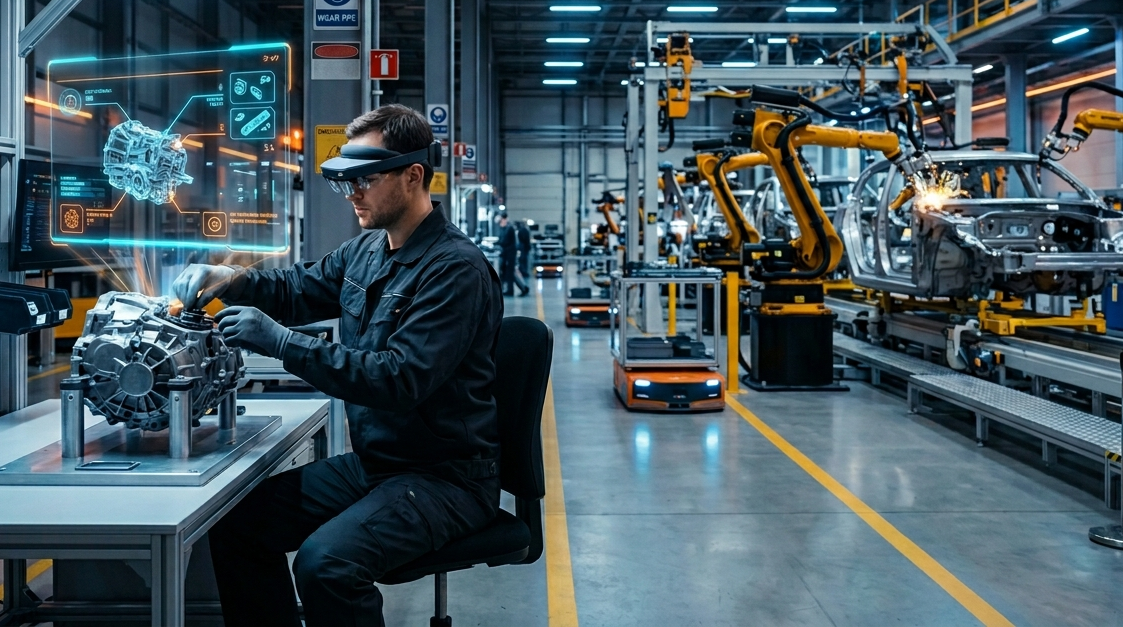
Train technicians to disassemble, diagnose, and reassemble complex machinery in VR — reducing downtime during live maintenance and improving first-time fix rates.
Assembly Line Operations
Replicate production line sequences — product assembly, component fitting, torque specs, and quality checks — enabling error-free performance on the actual line.
Quality Control Procedures
Train QC inspectors to identify defects, dimensional non-conformances, and surface flaws on virtual products — with graded accuracy scoring and re-training loops.
Anode Change & Process Operations
Specialised for aluminium smelting, steel making, and chemical processing — simulate extreme-environment operations (molten metal, high pressure, toxic gases) safely in VR.
Client Success

Manufacturing in Action

a leading aluminium manufacturer VR Anode Change Training
Aluminium Smelting
a leading aluminium manufacturer Industries Ltd. — Aditya Birla Group
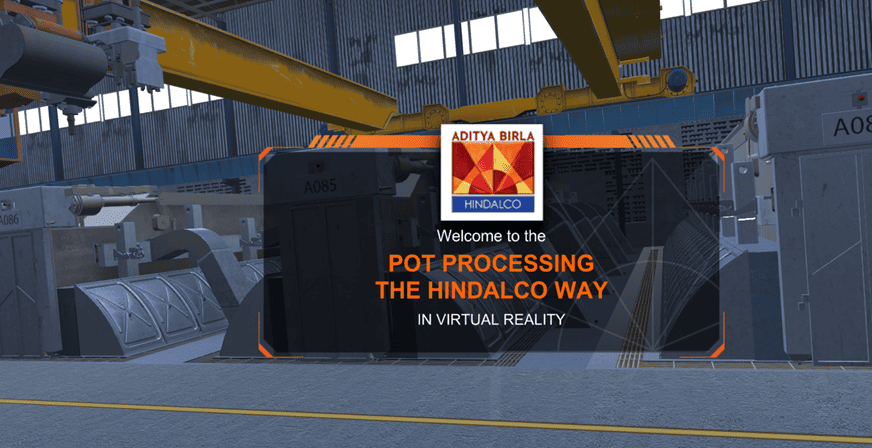
VR Pot Processing Safety Training for Anode Change Operations
ChallengeAnode change operations involve molten metal at >900°C, toxic fumes, and a complex multi-step procedure. Live training carried serious injury risk and knowledge transfer was inconsistent across multiple smelter facilities.
SolutionEDIIIE built a high-fidelity VR simulation titled "Pot Processing — The a leading aluminium manufacturer Way" replicating the actual smelter environment with guided Learn Mode and scored Practice Mode — zero physical hazard exposure.
OutcomeStandardised training across all smelter locations. Marked improvement in safety compliance scores and a significant reduction in near-miss incidents during actual operations.
↑40%
Faster Procedure Mastery
100%
Safe Training Environment
↓60%
Near-Miss Incidents
Why It Works

Why VR Works for Manufacturing Training

The immersive, hands-on nature of VR creates deeper learning outcomes than any classroom or e-learning programme.

4× Better Knowledge Retention
VR learners retain information 4× better than classroom training (PwC, 2020). Doing a task in VR activates procedural memory — the same pathway used in real-world execution — making learning stick.
Zero-Risk Skill Building
Trainees can make mistakes — and learn from them — without any consequence to themselves, equipment, or production. This psychological safety accelerates confidence and competence simultaneously.
Measurable, Scalable, Consistent
Every training run generates objective performance data. The same content delivers identical training quality across every facility and every batch — unlike trainer-dependent instruction that varies with every session.
Ready to Transform Your
Manufacturing Training?

Talk to our solutions team about a pilot programme tailored to your facility, workforce, and training objectives.

Frequently Asked Questions

Common Questions

Questions commonly asked by training managers, safety officers, and procurement teams — answered directly.

Statutory requirements vary by jurisdiction but typically include: general safety induction, fire safety and emergency evacuation, manual handling and ergonomics, PPE use and inspection, machine-specific operating procedures, LOTO (lockout/tagout) for maintenance personnel, and chemical safety where hazardous substances are used. In India, the Factories Act 1948 and associated state rules mandate safety training for all factory workers. Internationally, OSHA 29 CFR and ISO 45001 set the baseline. The specific modules required depend on the hazard profile of the facility and the roles of individual workers.
Manufacturing plants contain hazards — press rooms, conveyor systems, chemical stores, high-temperature processes — that cannot be safely replicated for training purposes. VR allows workers to experience and respond to these hazard scenarios in a photorealistic replica of their actual facility, building correct safety behaviours before they encounter real risk. Clients report 60–70% reductions in recordable incidents after deployment. The mechanism is experiential learning under realistic conditions — significantly more effective than classroom instruction or video for behavioural change.
A VR training system combined with a digital LMS allows multiple workers to train simultaneously — up to 12 per instructor — with certification generated automatically on passing. This makes it possible to certify hundreds of workers per week without proportionally increasing instructor resource. For shift-based manufacturing operations, training can run across all shifts using the same equipment and content, ensuring consistent certification standards regardless of which shift a worker is on. Certification records are held centrally and available for audit at any time.
The leading causes of serious injuries in manufacturing are: struck-by incidents (from moving machinery, falling objects, or fork trucks), caught-in or caught-between incidents (conveyor nip points, press operations, rotating equipment), falls from height and same-level slip/trip/fall, manual handling injuries (musculoskeletal damage from incorrect lifting or repetitive tasks), chemical exposure, and electrical incidents. Each of these has a direct corresponding VR training module that addresses the specific hazard recognition, avoidance behaviour, and emergency response.
VR training allows workers to be trained on new equipment — including equipment that does not yet exist on the factory floor — using a digital simulation built from engineering drawings and specifications. Workers learn operating sequences, fault recognition, and emergency stop procedures before the first time they touch live machinery. This eliminates the competency gap that typically occurs during machinery installation and runup, and significantly reduces operator-induced equipment damage during the initial operating period.
Traditional new worker onboarding requires experienced staff to step away from production to supervise and instruct. VR training runs independently — trainees work through induction and equipment familiarisation modules at their own pace, supervised by one trainer overseeing multiple headsets. Experienced workers return to production. For facilities with high turnover or seasonal peaks, this reduction in experienced worker absorption during onboarding has a direct impact on production output and quality.

Have a question not answered here?

Ask Us Directly