Book a DemoBack to Home
VR Training for Automotive
HomeIndustriesAutomotive
Automotive

VR Training for
Automotive Manufacturing

From engine assembly to EV battery systems — EDIIIE builds immersive VR simulations that onboard technicians faster, standardise assembly procedures across plants, and keep production quality and safety metrics consistently high.

55%
Reduction in Training Time
50%
Fewer Assembly Errors
40%
Faster New Model Launch Readiness
200%
Average ROI
The Problem

The Training Challenge in Automotive

Automotive manufacturing operates at the intersection of precision, speed, and safety — where training gaps translate directly into quality defects, line stoppages, and injuries.

Rapid New Model Launches
Every new model launch requires retraining large portions of the assembly workforce on new procedures, tooling, and quality standards — often under extreme time pressure. Traditional classroom and OJT methods cannot prepare workers at the speed and scale automotive product cycles demand.
EV Battery System Risks
Electric vehicle battery packs introduce hazards that traditional automotive workers have never encountered — high-voltage DC systems, thermal runaway risk, and electrolyte exposure. Training workers on EV battery assembly and service requires specialised content that most conventional training programmes lack entirely.
Human-Robot Collaboration Safety
Modern automotive plants increasingly deploy collaborative robots (cobots) alongside human workers. Safely integrating human and robotic workflows requires specific training on safe working distances, emergency stop procedures, and co-robot interaction protocols — content that is difficult and expensive to deliver with live robots.
Our Solution

VR Assembly & Safety Training Built for Automotive Production Speed

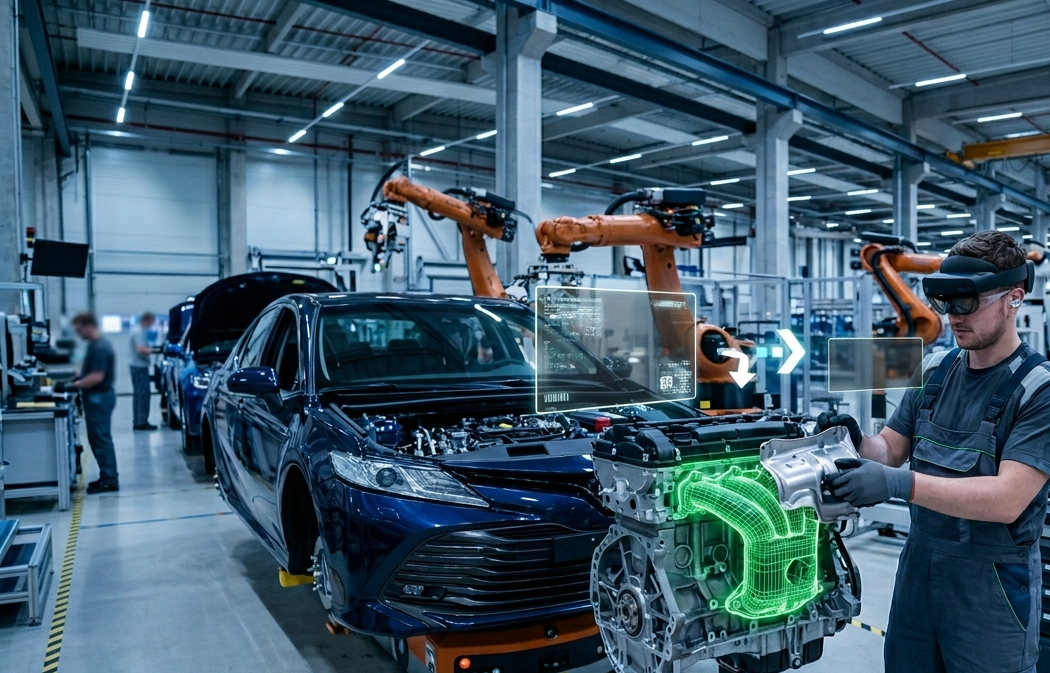
EDIIIE replicates your exact assembly stations, body shop processes, paint booths, and final line operations in photorealistic VR. Workers practice correct assembly sequences, torque specifications, quality checkpoints, and safety procedures — before they ever stand at a live station.

Our rapid content update capability allows new model launch training content to be pushed to all VR headsets simultaneously — enabling your entire workforce to train on new procedures weeks before production start, without a single minute of line disruption.

See a Demo
Automotive VR Training
Assembly Sequence Training
Guided VR walkthroughs of exact assembly tasks — component sequencing, torque specifications, fitment checks — for any model variant or production variant.
EV Battery & HV Safety
Dedicated high-voltage safety training for EV assembly and service — PPE requirements, isolation procedures, thermal runaway response, and rescue protocols.
Paint Booth & Surface Quality
Train painters and quality inspectors on spray technique, defect identification, and chemical safety in a paint booth environment — without VOC exposure or product waste.
New Model Launch Acceleration
Rapid deployment of VR training content for new model procedures across all plants simultaneously — cutting new model readiness time and reducing launch-phase quality defect rates.
55%
Reduction in Assembly
Training Duration
50%
Reduction in First-Time
Assembly Errors
40%
Faster New Model
Launch Readiness
200%
Average ROI on
VR Training Investment
Applications

VR Use Cases in Automotive Manufacturing

Across the entire automotive value chain — from body shop to delivery — VR training drives faster ramp-up and higher quality standards.

Body Shop Operations
Welding, joining, hemming, and structural assembly training in VR — building correct technique before operators work on actual body panels and structural components.
Safety & Ergonomics Training
Simulate ergonomic risk scenarios — awkward postures, repetitive strain, manual handling — to train workers on correct body mechanics and injury prevention techniques.
Powertrain Assembly
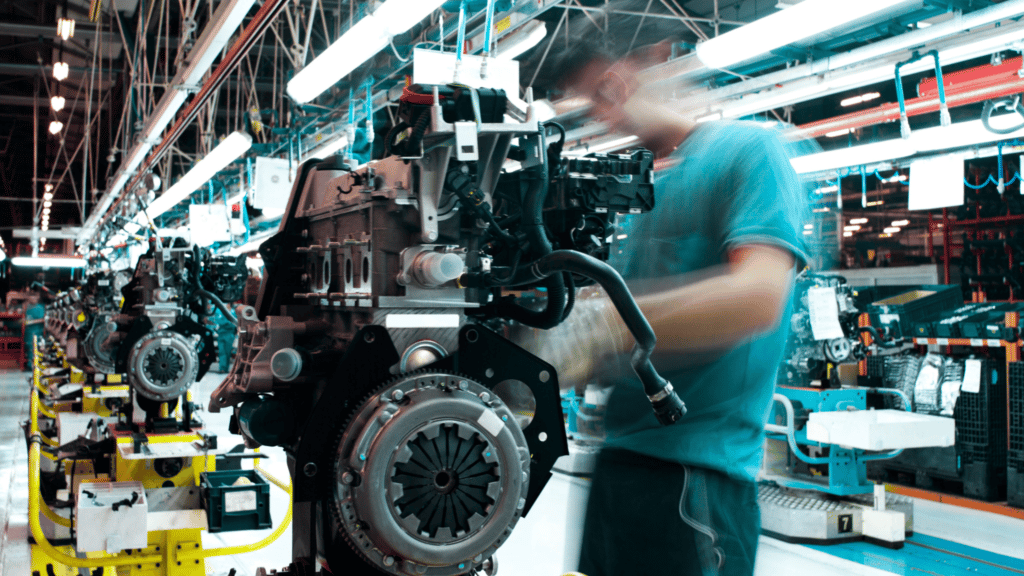
Engine and transmission assembly procedure training — torque sequences, component identification, and quality check points — for both ICE and electric powertrain variants.
Quality Control & Inspection
Train QC inspectors to identify surface defects, dimensional variations, fitment issues, and electrical system faults on virtual vehicles — with graded accuracy scoring and gap analysis.
EV Charging & Service
Train dealer service technicians on EV-specific diagnostics, charging system service, battery management system interpretation, and high-voltage safety protocols for the growing EV aftermarket.
Cobot & Robot Cell Safety
Simulate collaborative robot cell interactions — safe working zones, emergency stop procedures, recovery from robot faults, and re-start protocols — building safe habits around advanced automation.
Why It Works

Why VR Works for Automotive Training

Automotive manufacturing demands precision, speed, and safety simultaneously — VR is the only training technology that develops all three without disrupting production.

Accelerate Time to Productive
VR-trained workers reach acceptable production quality levels faster than OJT-trained counterparts. For automotive manufacturers where every day of reduced first-time quality costs real money, faster ramp-up to standard has immediate financial impact on launch economics.
Deploy Across All Plants Simultaneously
When your new model launches across three plants in two states, VR ensures every worker at every plant gets identical training on the same day — no lag, no variance, no dependency on local trainer quality or availability.
Build Quality Culture, Not Just Compliance
Immersive VR creates genuine understanding of why procedures matter — by letting workers experience the consequences of errors in simulation. This builds a quality mindset, not just rote compliance with instruction sheets — the difference between a truly quality-conscious workforce and a merely compliant one.
Case Study Spotlight

Automotive VR Training in Action

Real enterprise deployments. Measurable outcomes. Verified by clients.

Automotive Assembly VR Training

Automotive Assembly VR Training

images/industry-automotive.jpg

Automotive Manufacturing
Leading Passenger Vehicle OEM
Assembly Line Operator Training — Torque, Sequence & Quality Checks

VR training for assembly line operators covering critical torque sequences, part fitment verification, and quality checkpoint procedures — with scenario-based fault detection exercises and digital competency tracking.

↓58%
Assembly Errors
↑89%
First-Pass Quality
Onboarding Speed
View Case Studies
Automotive Retail VR Product Training

Automotive Retail VR Product Training

images/industry-automotive.jpg

Automotive Retail
National Dealer Network
VR Product Training for Sales & Service Advisors

Immersive product knowledge training enabling sales advisors to walk customers through vehicle systems in VR — covering engine variants, safety features, and competitive differentiators without a live vehicle.

↑72%
Product Knowledge
↓45%
Training Time
↑35%
Customer Satisfaction
View Case Studies
View All Case Studies
Ready to Accelerate Your
Automotive Training Programme?

Connect with our automotive training specialists to design a VR solution that matches your production cadence, model range, and workforce scale.

Frequently Asked Questions

Common Questions

Questions commonly asked by training managers, safety officers, and procurement teams — answered directly.

Automotive manufacturing plants are subject to comprehensive safety training requirements covering: general site induction and hazard awareness, press and stamping area safety, robot cell access and exclusion zone management, chemical safety for paint shop and body shop environments (coatings, adhesives, solvents), manual handling and ergonomics (repetitive assembly tasks), electrical safety for EV battery systems, LOTO for maintenance personnel, fork truck and materials handling equipment safety, and fire safety. Requirements are set by the Factories Act and state rules in India, and by OSHA, ISO 45001, or equivalent frameworks internationally.
Automotive manufacturing combines high-speed machinery, chemical hazards, heavy materials handling, and increasingly, high-voltage EV battery systems — a complex safety training requirement that cannot be adequately addressed through classroom instruction alone. VR allows workers to experience and respond to press room incidents, robot cell violations, chemical exposure scenarios, and HV electrical emergencies in a photorealistic simulation of their actual production line. For skills training, VR enables assembly sequence practice on new vehicle models before production lines are built, eliminating the competency gap at model changeover.
Automotive plants with multiple shifts, high turnover in some roles, and large seasonal or contract workforce peaks require a training and certification system that scales without proportionally increasing trainer headcount. A VR training system with integrated LMS allows multiple workers to train simultaneously per instructor, with digital certification issued automatically on passing. For global OEMs and dealer networks, the same platform deploys consistent training standards across all plants and dealer locations, with a central compliance dashboard covering the entire organisation.
New model launches introduce new components, revised assembly sequences, and changed quality requirements — creating a temporary competency gap even in experienced workers. VR training built from engineering drawings and assembly specifications allows workers to practise the new model's assembly procedure before physical prototypes or production line reconfiguration exist. Workers arrive at Job 1 with meaningful simulated experience, reducing the ramp-up time for quality and output rate that typically follows every model changeover. This is one of the highest-ROI applications of VR in automotive manufacturing.
The majority of assembly quality defects are attributable to incorrect process execution — wrong torque, wrong sequence, missed checkpoints — rather than material or design failures. VR training embeds the correct sequence and checkpoint behaviour into workers before they reach the line, and can be updated immediately when process changes occur. Competency assessment data from VR training identifies which workers and which process steps carry the highest error risk, allowing targeted intervention before defects occur on production vehicles rather than after.
High-voltage EV battery systems present electrical hazards that are categorically different from conventional automotive systems. Required training covers: HV system identification and warning label recognition, HV isolation procedures before any maintenance work, safe approach distances and arc flash risk, correct PPE selection and use for HV work, emergency response to HV electrical incidents including shock, burn, and thermal runaway events, and battery storage and handling requirements. As OEMs and dealer networks expand EV capability, this training gap is one of the most significant workforce safety risks in the automotive sector.

Have a question not answered here?

Ask Us Directly