Book a DemoBack to Home
Digital Twin Industrial Plant Simulation
Digital Twin Solutions

Your Facility.
Digitally Twinned.

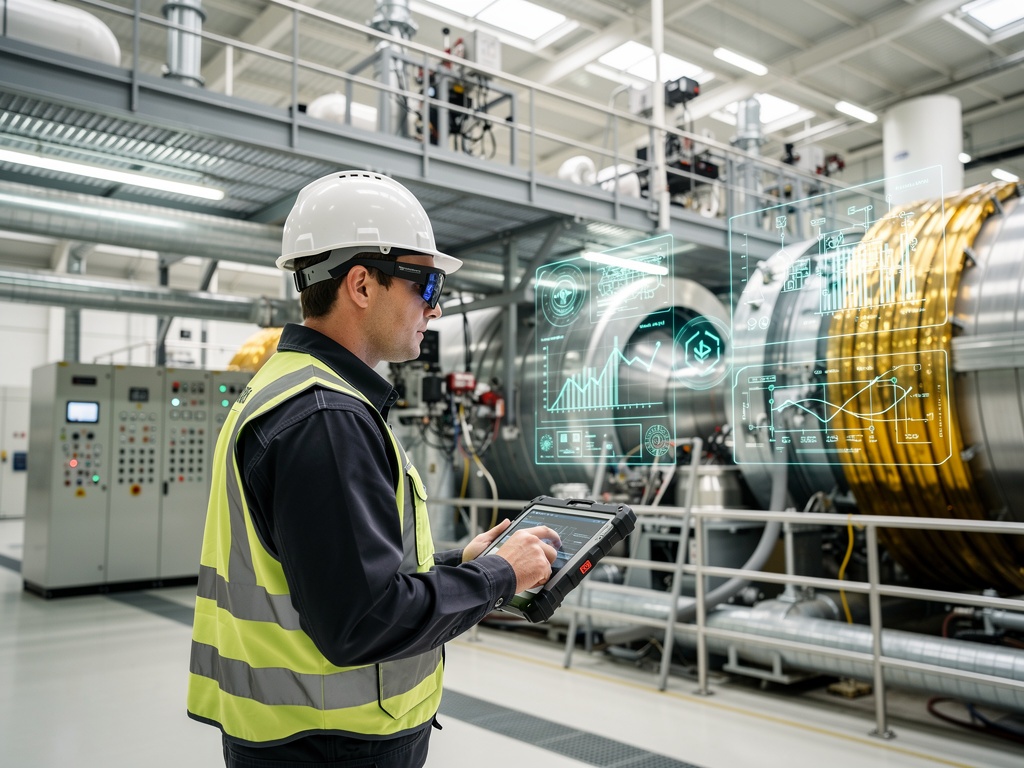
A Digital Twin is a precise, interactive digital replica of your plant, equipment, or process — connected to real operational data or built for simulation. Use it for training without touching live systems, monitoring operations in real time, or rehearsing complex procedures before they happen.

30%
Reduction in Downtime
50%
Lower Pre-Commissioning Cost
170+
Enterprise Projects
10+
Years of Expertise
The Business Case

Why Organisations Need Digital Twins

Complex industrial assets generate enormous risk and cost when the only way to understand them is to interact with the real thing.

Training on Live Systems Is Risky
Operators learning on live plant — turbines, substations, chemical reactors — risk expensive damage and safety incidents. A Digital Twin eliminates this risk completely.
Pre-Commissioning Delays Are Costly
Teams that first interact with complex equipment during commissioning discover problems expensively. A Digital Twin lets engineers, operators, and maintenance teams explore and train months before go-live.
No Visibility Into Distributed Assets
Organisations with multiple sites have limited real-time visibility into asset performance. Digital Twins centralise that view spatially and operationally.
Reactive Rather Than Predictive Maintenance
Without a digital model tracking asset behaviour, maintenance is event-driven — meaning failures are discovered after they have caused downtime rather than before.
Our Digital Twin Approach

What EDIIIE Digital Twins Deliver

We build Digital Twins from your engineering data, equipment specifications, and operational processes — creating accurate, interactive replicas that are immediately useful for training and operations.

Process-Accurate 3D Replica
Built from your P&IDs, CAD files, and engineering drawings — a spatially accurate digital replica of your facility that mirrors the real thing down to instrumentation and layout.
Live Data Integration
Connect your Digital Twin to SCADA, DCS, IoT sensors, and real-time operational data — transforming a static model into a live monitoring dashboard with spatial context.
Simulation-Based Training
Operators train on the Digital Twin rather than the live plant — practising startups, shutdowns, fault diagnosis, and emergency procedures with realistic system responses.
Predictive Maintenance Modelling
Model equipment degradation and failure modes against real operational data — identifying maintenance needs before failures occur and optimising asset lifecycle.
Pre-Commissioning Rehearsal
Walk engineering, operations, and safety teams through the facility digitally before it is built or commissioned — identifying spatial conflicts and training requirements months early.
Performance Benchmarking
Simulate process changes or equipment configurations digitally before implementing them physically — quantifying expected outcomes and risks without real-world disruption.
Applications

Where Digital Twins Create the Most Value

Digital Twins are most powerful in capital-intensive, high-complexity environments where the cost of physical mistakes is high.

Power Generation & Utilities
Turbine operations, substation management, and high-voltage system training on a Digital Twin — before operators ever approach live equipment.
Oil, Gas & Petrochemical
Rig operations, refinery processes, and pipeline management trained and monitored on Digital Twins — realistic system responses without live process risk.
Infrastructure & Megaprojects
Metro rail, airport, and highway infrastructure projects use Digital Twins for pre-commissioning walkthroughs and multi-contractor coordination.
Manufacturing Plant Simulation
Model production lines, simulate process changes, and train operators on new equipment configurations before physical installation.
Hospital & Healthcare Facilities
New hospital wings, operating theatre configurations, and medical equipment installations reviewed and trained on digitally before patients arrive.
Defence & Critical Infrastructure
Highly sensitive or inaccessible assets modelled digitally — giving operators procedural competency without access to classified or dangerous physical systems.
In Deployment

Digital Twin Deployments

Real deployments. Enterprise environments. Measurable outcomes.

Digital Twin — Full Plant Visualisation

images/dt-plant-visualisation.jpg

Digital Twin — Live Operations Dashboard

images/dt-operations-dashboard.jpg

Digital Twin — Pre-Commissioning Rehearsal

images/dt-precommission.jpg

The EDIIIE Difference

Why Organisations Choose Us

We are not a generic content studio. We are an immersive simulation company with domain expertise across every sector we serve.

Process-Accurate Simulation
Built from your SOPs, engineering drawings, and equipment specs — validated by your SMEs before any deployment.
End-to-End Delivery
Strategy, design, development, deployment, and analytics — all from one team. No fragmented vendors, no gaps.
200+ In-House Specialists
Developers, 3D artists, instructional designers, and domain experts — all in-house for quality and speed.
Proven at Global Scale
170+ enterprise projects across defence, heavy industry, aerospace, healthcare, and government worldwide.
Build a Digital Twin of Your Facility

From a single asset to an entire plant — we'll scope a Digital Twin programme that fits your operational priorities and budget.

Frequently Asked Questions

Common Questions

Questions commonly asked by training managers, safety officers, and procurement teams — answered directly.

A Digital Twin is a live or simulatable digital replica of a physical asset, process, or facility. Unlike a static 3D model, a Digital Twin reflects real operational behaviour — it can be connected to live sensor and process data to mirror actual plant state in real time, or driven by physics-based simulation to model how a system behaves under different conditions. It is used for operator training, operational monitoring, predictive maintenance, pre-commissioning rehearsal, and change management — allowing decisions and training to happen in the digital replica before affecting the physical asset.
Construction starts with capture of the physical and functional reality of the asset — combining site surveys, LiDAR laser scanning, equipment documentation, P&ID review, and process data analysis. This data is processed into a high-fidelity 3D environment with accurate component geometry and process behaviour. Data connectivity is then layered in — live SCADA or DCS feeds for an operational twin, or physics-based simulation models for a training twin. The process typically takes 12–20 weeks for a significant plant section, depending on complexity and data availability.
A 3D model is a static visual representation — it looks like the asset but does not behave like it. A Digital Twin is dynamic — it reflects or simulates the behaviour of the real asset, including process responses, equipment states, fault conditions, and real-time operational data. You can train operators on a Digital Twin because the simulated plant responds correctly to their actions. You cannot do that with a 3D model. The value of a Digital Twin comes from its accuracy and interactivity, not its visual fidelity.
Yes. Operational Digital Twins can consume live process data from SCADA, DCS, and historian systems via standard industrial protocols including OPC-UA, MQTT, and REST API. This allows the twin to reflect real-time plant state — showing current pressures, temperatures, flow rates, and equipment status. Training twins can also run in simulation mode, fully isolated from live plant, allowing operators to practise abnormal conditions and fault scenarios without any risk to operations. The two modes can coexist — operators train on the simulation twin and monitor operations on the live twin.
A training Digital Twin allows operators to practise equipment operation, abnormal condition response, and emergency procedures in a high-fidelity simulation of their actual plant — without any risk to operations or equipment. Instructors can inject faults, create abnormal process conditions, and run scenario progressions that operators may never encounter during normal operations but must respond to correctly when they do. This is particularly valuable for pre-commissioning training (training operators on a new plant before it exists physically) and for maintaining competency in low-frequency, high-consequence events.
ROI comes from multiple sources: operator training (eliminating production downtime, reducing incident costs, accelerating new operator readiness), pre-commissioning (operators arrive at plant startup with simulated experience, reducing commissioning time and startup incidents), operational optimisation (running process scenarios in the twin before implementing on real plant), and maintenance planning (validating maintenance procedures and access strategies virtually before scheduling physical work). For major industrial facilities, Digital Twin ROI is typically measured over a 3–5 year horizon, with training and commissioning value realisable in year one.

Have a question not answered here?

Ask Us Directly