Book a DemoBack to Home
VR Training for Healthcare
HomeIndustriesHealthcare
Healthcare

VR Training for
Healthcare & Medical Institutions

Where patient safety leaves no margin for error — EDIIIE builds immersive VR simulations that let clinicians and healthcare workers practice critical procedures repeatedly without risk to patients.

40%
Faster Clinical Skill Acquisition
87%
Post-Training Confidence (Survey)
35%
Fewer Clinical Errors in First Months
Better Retention vs. Textbooks
The Problem

The Training Challenge in Healthcare

Healthcare training has an irreducible tension — you cannot develop clinical competence without practice, but practice errors in real clinical settings harm patients.

Limited Patient Exposure
Medical and nursing students and junior clinicians need repeated exposure to diverse clinical scenarios to develop competence. Patient availability, case mix unpredictability, and ethical constraints on training with vulnerable patients severely limit the quality and quantity of hands-on practice opportunities.
High-Stakes, Low-Frequency Events
Cardiac arrest, anaphylaxis, emergency airway management — these are the events where clinical teams must perform flawlessly, yet they occur rarely enough that most staff never develop deep procedural fluency through real exposure. Annual classroom refreshers are wholly inadequate for rare but critical emergencies.
Medical Device Complexity
Modern healthcare involves complex equipment — ventilators, infusion pumps, imaging systems, surgical robots — that takes significant time to master. Training on live equipment during patient care introduces patient safety risk, while expensive simulators are available only in limited numbers.
Our Solution

Immersive VR Clinical Training That Protects Patients and Builds Competence

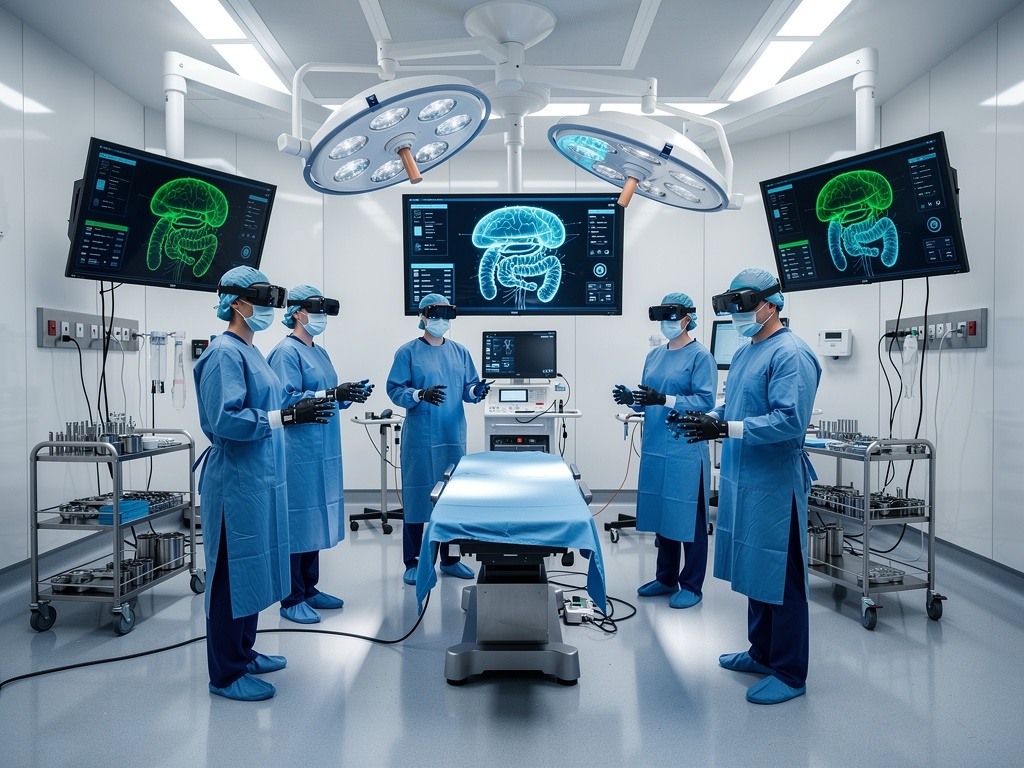
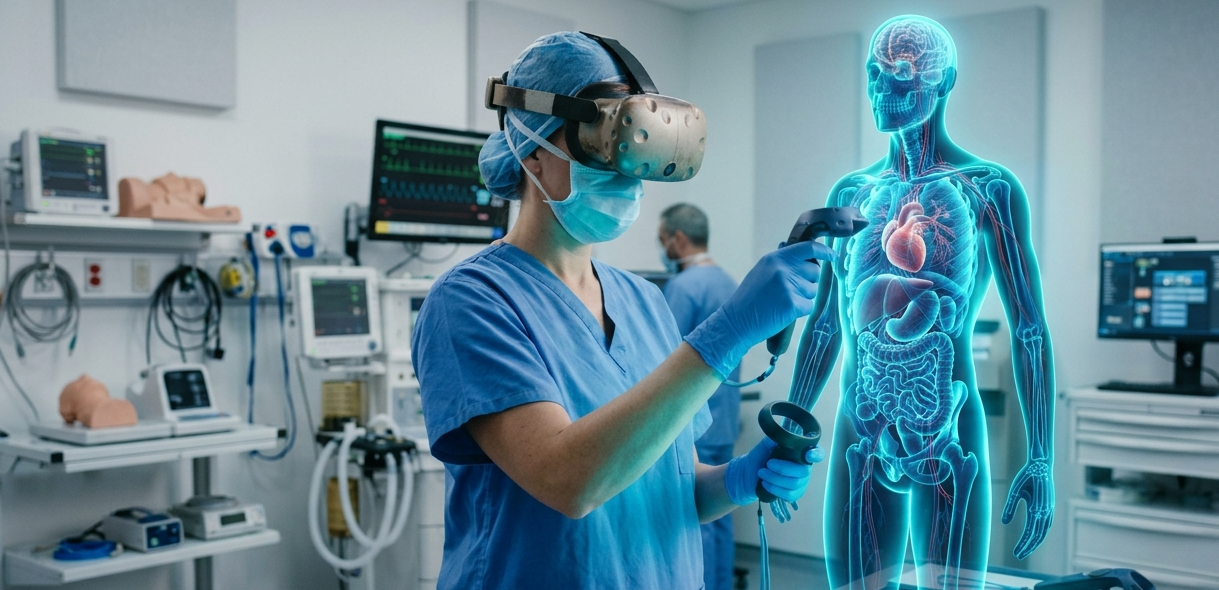
EDIIIE creates clinically accurate VR environments — operating theatres, ICUs, emergency departments, wards — where healthcare professionals can practice procedures, respond to emergencies, and develop device familiarity through unlimited repetitions without any risk to real patients.

Our solutions have been deployed with leading institutions including AIIMS Delhi and Indian Spinal Injuries Centre — delivering measurable improvements in clinical skill scores and emergency response times.

See a Demo
Healthcare VR Training
Clinical Procedure Simulation
Step-by-step VR practice for intubation, catheterisation, cannulation, wound closure, and other common clinical procedures.
Emergency Response Drills
Cardiac arrest management, anaphylaxis protocols, trauma response — practised repeatedly in immersive emergency department scenarios.
Medical Device Training
Virtual replicas of ventilators, infusion pumps, ECG machines, and imaging equipment — allowing staff to develop device fluency before patient contact.
Multi-Disciplinary Team Training
Simulate multi-professional team responses to complex clinical scenarios — improving communication, role clarity, and leadership under pressure.
40%
Faster Clinical
Skill Acquisition
87%
More Confident
Trainees vs. Textbook
35%
Reduction in Clinical
Errors in First 3 Months
Better Retention
vs. Didactic Teaching
Applications

VR Use Cases in Healthcare Training

From bedside procedures to complex surgical simulations — EDIIIE covers the full spectrum of clinical and healthcare training needs.

Injection & IV Access Training
Practice venepuncture, IV cannulation, IM and SC injections in a lifelike VR patient simulation — developing correct technique without anxiety or patient discomfort.
Airway Management
Simulate intubation, bag-mask ventilation, surgical airway procedures, and difficult airway management — critical skills that require extensive repetition to master safely.
Mass Casualty Response
Train hospital teams on surge protocols, triage decision-making, and resource allocation for mass casualty incidents — scenarios that cannot be practised effectively any other way.
Spinal Injury & Rehabilitation
Train physiotherapists and rehabilitation staff on spinal injury patient handling, transfer techniques, and assistive device use — reducing secondary injury risk during care.
Medication & Pharmacology Training
Interactive VR scenarios covering drug calculation, administration routes, anaphylaxis management, and medication error prevention — building pharmacological safety awareness.
Infection Control & PPE Protocols
Practice donning/doffing PPE, isolation precautions, and outbreak response procedures — reinforcing infection control behaviours that protect both patients and staff.
Why It Works

Why VR Works for Healthcare Training

In medicine, practice makes perfect — but in the real world, imperfect practice costs lives. VR solves this fundamental challenge.

Unlimited Safe Repetition
Procedural competence requires repetition — but every repetition on a real patient carries risk. VR allows clinicians to perform a procedure 50 times before ever touching a patient, building genuine muscle memory and confidence through consequence-free practice.
Objective Assessment Beyond "Sign-Off"
VR doesn't just observe — it measures. Every hand movement, every decision, every timing is recorded. Trainers can review a clinician's actual performance data, not just their supervisor's impression — enabling precise identification of skill gaps.
Emotional Realism, Physical Safety
VR can simulate the stress, urgency, and emotional weight of a real clinical emergency — the alarms, the team dynamics, the time pressure — while keeping the learning environment completely safe. This prepares clinicians for the psychological as well as procedural demands of real emergencies.
Case Study Spotlight

Healthcare VR Training in Action

Real enterprise deployments. Measurable outcomes. Verified by clients.

Medical VR Clinical Skills Training

Medical VR Clinical Skills Training

images/industry-healthcare.jpg

Medical Education
Premier Ayurvedic Medical Institution, Jaipur
VR Clinical Skills Training for Medical Students

Immersive VR modules for procedural skills training — enabling students to practise clinical procedures in a photorealistic environment before performing on patients, with scored assessment and automated reporting.

↑87%
Post-Training Confidence
↓55%
Training Cost
Practice Frequency
View Case Studies
Hospital Emergency Response VR Training

Hospital Emergency Response VR Training

images/industry-healthcare.jpg

Hospital Training
Multi-Speciality Hospital Group
Emergency & First Response VR Training for Clinical Staff

ALS and BLS simulation modules with AI-integrated feedback — covering cardiac arrest response, airway management, and mass casualty triage for nursing and paramedical staff.

↑90%
Protocol Adherence
↓60%
Error Rate
Drill Access
View Case Studies
View All Case Studies
Ready to Elevate
Clinical Training Standards?

Explore how EDIIIE can design a VR clinical training programme for your hospital, medical college, or healthcare system.

Frequently Asked Questions

Common Questions

Questions commonly asked by training managers, safety officers, and procurement teams — answered directly.

Healthcare workers are subject to training requirements across clinical safety, infection control, fire safety, manual handling (patient and equipment), waste management (clinical and sharps waste), data privacy, and role-specific clinical competencies. In India, NABH accreditation standards set training requirements for hospital staff. Internationally, CQC (UK), Joint Commission (US), and ISO 45001 apply. Clinical staff additionally require training in BLS/ALS protocols, PPE use for infection control, radiological safety (where applicable), and emergency response procedures specific to the clinical environment.
Healthcare training has a fundamental constraint: practising clinical procedures on real patients carries patient safety risk. VR removes this constraint entirely — clinical staff can practise emergency procedures, invasive techniques, and high-risk protocols in a realistic simulation without any patient involvement. Research consistently shows VR clinical training produces higher retention than manikin-only simulation, and VR allows unlimited repetition at any time of day without consuming manikin or simulation suite availability. For emergency response training specifically, VR creates time-pressured scenarios that classroom training cannot replicate.
Large hospital groups and healthcare networks face the challenge of delivering consistent, high-quality training to thousands of clinical and non-clinical staff across multiple facilities. VR training modules run on standalone headsets with one trainer overseeing multiple simultaneous trainees — making it possible to run training continuously across all shifts without proportionally increasing training staff. The LMS tracks completion and certification across all facilities from a single dashboard, enabling compliance management at organisational level rather than per-department.
Emergency response training has traditionally required pulling clinical staff from wards for simulation centre sessions — costly in staff time and disruptive to care delivery. VR emergency training runs on a headset in any available space — a meeting room, a break room, a training bay — without requiring a simulation centre or specialist manikins. Scenarios run in 15–30 minutes per session. Staff can complete training during quieter periods without block-releasing from clinical duties. This makes high-frequency emergency training logistically viable at scale.
VR is most effective for scenarios where the training objective requires realistic time pressure, spatial awareness, or the experience of rare but critical events. The strongest clinical applications are: cardiac arrest and ALS/BLS response, major trauma and emergency airway management, sepsis recognition and early intervention, anaphylaxis management, mass casualty triage, infection control procedure adherence (where VR can visualise contamination), and procedural skills requiring spatial orientation. Scenarios that are purely cognitive or communication-based are better suited to other training formats.
Yes. A substantial and growing body of evidence shows simulation-based training improves clinical performance in measurable ways. Studies across emergency medicine, anaesthesia, surgery, and nursing show improvements in procedural accuracy, adherence to protocols, team communication, and time-to-intervention. In practical deployments, hospitals report improved emergency response scores, reductions in procedural errors, and better compliance with infection control protocols after structured simulation training programmes. The mechanism is the same as in industrial training — doing is more effective than watching or reading.

Have a question not answered here?

Ask Us Directly